
Sex Offender Checks in Maui County
The Hawaiʻi Sex Offender and Other Covered Offender Search is the first official channel for a Maui County sex offender search. The Hawaiʻi Criminal Justice Data Center, or HCJDC, maintains it and refreshes public information nightly. It covers sex offenders and offenders against minors whose records meet Hawaiʻi's publication rules. One narrow group is not public: a person whose only covered conviction was a single misdemeanor that did not involve a minor.
Start with the strongest detail you have. A full name works for a known person, while an address, city, ZIP, or radius fits a neighborhood check. Search several spellings when a name may have changed. A listing is based on a covered conviction, but it is not fingerprint-confirmed identity and does not rate future risk. Compare aliases, birth year, physical description, photograph, and location before deciding whether the result concerns the right person.
The state portal is the public list for all of Maui County. MPD does not publish a second county offender map, and the Wailuku, Lānaʻi, and Molokaʻi registration counters should not be treated as competing databases. This matters when search results seem thin: changing from a place query to a name query is more useful than hunting for a local list that does not exist. When a search still produces doubt, general registry questions can go to HCJDC, while an immediate safety concern belongs with law enforcement.
Maui Registry Listings Are Not Risk Scores
A Maui County registry result answers whether Hawaiʻi law requires publication of a covered offender's information. It does not assign a public danger level. Tier labels address the legal path and waiting period for ending registration, not the odds that a person will reoffend. Even a current photograph and address cannot replace a positive fingerprint comparison when identity truly matters.
Read the status, not into it. Registered, non-compliant, absconded, out-of-state, and incarcerated describe registry administration, not a personal safety forecast.
Conviction-based also means the public record has a defined legal source. It does not mean every past accusation, dismissed charge, or non-covered offense belongs on the profile. A person who does not appear may fall outside the law's public categories, may be entered under a different name, or may be registered in another jurisdiction. None of those possibilities supports a claim about guilt or safety. The sound response is to refine the official search and use NSOPW when another state may be involved.
How to Search the Hawaiʻi Registry
HCJDC offers both person and place-based paths through the official registry. Maui County users must accept the portal conditions and complete its reCAPTCHA before results load. A broad search can use an offender type or status; a focused query can combine a name with place information. ZIP and radius work differently, so choose the control that matches the question.
- Open the state search, read the use warning, and choose a name or address search.
- Enter known terms, choose offender type or status if useful, and complete reCAPTCHA.
- Review possible matches by alias, birth year, photograph, description, and Maui location.
- Open the profile, note its compliance status, then verify uncertain identity through an official agency.
| Field Label | Type | Required | Notes |
|---|---|---|---|
| Offender Type | Dropdown | No | All, Sex Offender, or Offender Against Minor |
| Covered Offender Status | Dropdown | No | Registered, Non-Compliant, Absconded, Out-of-State, or Incarcerated |
| First and Last Name | Text | No | Use either or both; check aliases on a possible profile |
| Street Name and City | Text | No | Supports a Maui County location search |
| Radius | Dropdown | No | One, two, or three miles; ZIP is ignored in radius mode |
| ZIP | Dropdown | No | All or a selected Hawaiʻi ZIP |
| reCAPTCHA | Challenge | Yes | Must be completed before submitting |
The status filter is especially helpful when a broad name produces many matches. Registered is not interchangeable with incarcerated, and confirmed out-of-state is not the same as absconded. Clear the form between different search approaches so an old filter does not silently narrow a new query. For an address check, try the street name and city first, then run the radius option as a separate search. The site may display qualifying stay, work, or school information on the opened profile even when those details were not available as initial search fields.
Maui Offender Radius Searches
The address tool can scan one, two, or three miles around a Maui County location. That is useful for community awareness near a home, school route, park, or other familiar place. Radius mode disregards the ZIP selector, so enter the street and city with care. An address search also has limits: the portal warns that location data may not be exact or current, and a temporary or future residence may appear with an actual residence.
HRS chapter 846E does not impose one statewide distance rule that keeps all registrants away from schools, parks, or similar locations. Individual probation, parole, or court conditions may be stricter. Do not infer a violation merely because a profile location looks close to a landmark.
Geography on Maui also calls for care. A short radius does not describe travel time, terrain, island separation, or the way a neighborhood is reached by road. It only measures distance around the submitted location within the portal's tool. Searchers on Molokaʻi or Lānaʻi should use the island's correct city or ZIP and should not assume a Maui island result represents the whole county. Repeating the query with nearby place terms can catch an address entered differently without turning the search into speculation.
Inside a Maui County Registry Profile
A public profile combines identity, location, conviction, and compliance fields authorized by HRS §846E-3. It can show much more than a name, so review the whole inventory. Hawaiʻi withholds victim identity. It also cautions that an address cannot be guaranteed, which is why the result is best used as an awareness aid rather than a claim about a person's current location.
| Name and Aliases | Displayed names plus birth year for identity comparison |
|---|---|
| Photo and Description | Recent photo, traits, scars, tattoos, and marks |
| Locations | Actual, temporary, or future residence and qualifying stays |
| Work and Education | Employment area, professional licenses, school affiliation, and dates |
| Vehicles | Year, make, model, color, and plate for vehicles, watercraft, or aircraft |
| Offense and Judgment | Covered offense plus conviction or judgment information |
| Registration Status | Administrative compliance state and relevant law |
Some fields need context. Work information may show a street and ZIP or only a work area. Educational information may name an institution and affiliation dates. Vehicle details can aid identification, but ownership and use can change. The profile may include actual, temporary, and future residence information because Hawaiʻi registration duties cover more than one type of stay. A future location is not necessarily a present one. Read the labels and dates together, and avoid lifting one field out of the record as if it settled current identity or location.
Maui County Offender Registration Offices
Public searching happens online, while covered offenders complete duties with law enforcement. The main Maui County location is MPD Records in Wailuku. The State Sheriff Division also takes Friday appointments at Hoapili Hale, and island-specific MPD locations serve Lānaʻi and Molokaʻi. These contacts do not keep separate public lists.
MPD Records
55 Mahalani Street
Wailuku, HI 96793
(808) 244-6345
State Sheriff Division
Hoapili Hale, Wailuku
(808) 244-2905
Friday by appointment only
Neighbor-Island MPD
Lānaʻi: 855 Fraser Avenue, (808) 565-6428
Molokaʻi: 110 Ainoa Street, (808) 553-5355
The HCJDC covered-offender program page explains the program and gives registry help at (808) 587-3350.
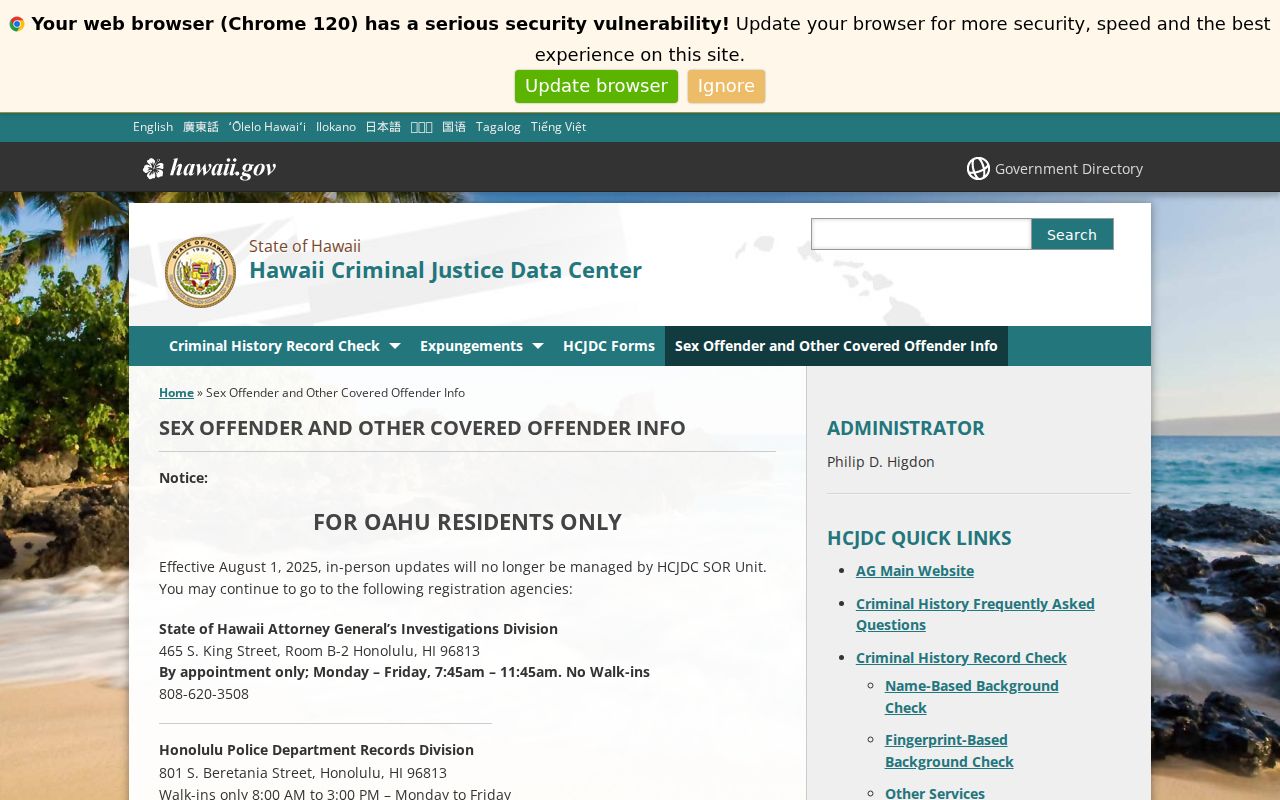
This guidance separates the duty to register at an office from the public's task of searching the Maui County registry.
Initial registration and later updates are official transactions. Covered people generally must act within three working days after a triggering event, while visitor duties begin after the statutory stay threshold. The counters also support the recurring in-person duties described below. Public users should call the listed office only for a legitimate agency question; the published profile and HCJDC help line remain the better routes for ordinary search assistance. Office hours and appointment practices can change, so confirm them before travel between islands or across Maui.
Hawaiʻi Registration Levels and Requirements
Hawaiʻi tiers set the earliest ordinary petition point for ending registration. They are not public risk rankings, and reaching a threshold does not end a duty by itself. A court looks for statutory eligibility, substantial compliance, a very low likelihood of reoffense, and whether registration still assists public safety.
| Level / Tier | Duration | Verification Frequency |
|---|---|---|
| Tier 1 | Petition after 10 compliant years | Quarterly mail plus annual in-person review |
| Tier 2 | Petition after 25 years | Quarterly mail plus annual in-person review |
| Tier 3 or repeat offender | Life under ordinary rule | Quarterly mail plus annual in-person review |
| Long-duration path | Petition after 40 years under §846E-10(f) | Duties continue unless court grants relief |
A denied termination petition generally prevents another petition for five years. The court requires proof greater than a preponderance that the legal tests are met, including substantial compliance and a very low likelihood of reoffense. The forty-year route is a petition opportunity under the long-duration provision, not an automatic removal date. Until a court grants relief, registration, verification, and update duties remain in force. This is another reason a public tier should never be rewritten as a danger category: the tier table is about duration and eligibility under Hawaiʻi law.
Maui Registration Verification Timeline
People with a permanent deliverable address receive nonforwardable verification during the first week of January, April, July, and October and must return it within ten days. Temporary or no-deliverable-address situations require quarterly in-person reporting. The annual in-person review and photograph occur within thirty days after a birthday. Initial or event-triggered registration is generally due within three working days.
A visitor crosses Hawaiʻi's registration threshold after staying more than ten days or a total of thirty days in a calendar year. These timing rules explain why a Maui County listing can change after a move, visit, custody event, or yearly review. They also explain why the nightly portal update should not be treated as real-time tracking.
Verification mail is nonforwardable, which makes a current deliverable address central to that process. A person without one cannot simply wait for a letter and instead reports in person each quarter. Annual review adds a fresh photograph to the compliance cycle. Changes between those set points can create separate reporting duties. For the public, the practical lesson is modest: check the profile's status and available dates, but leave the determination of compliance to HCJDC and the registering agency.
Maui Registry E-Alerts and NSOPW
HCJDC's portal offers e-alerts tied to proximity or address changes. A Maui County user can register for notices around selected places instead of repeating the same location search. Alerts are prompts to reopen the official profile and confirm its current fields, not proof that a person moved or violated a rule.
For a search that crosses Hawaiʻi's border, use the National Sex Offender Public Website. NSOPW queries participating public registries across jurisdictions, while Hawaiʻi's portal supplies deeper state fields and local address controls.
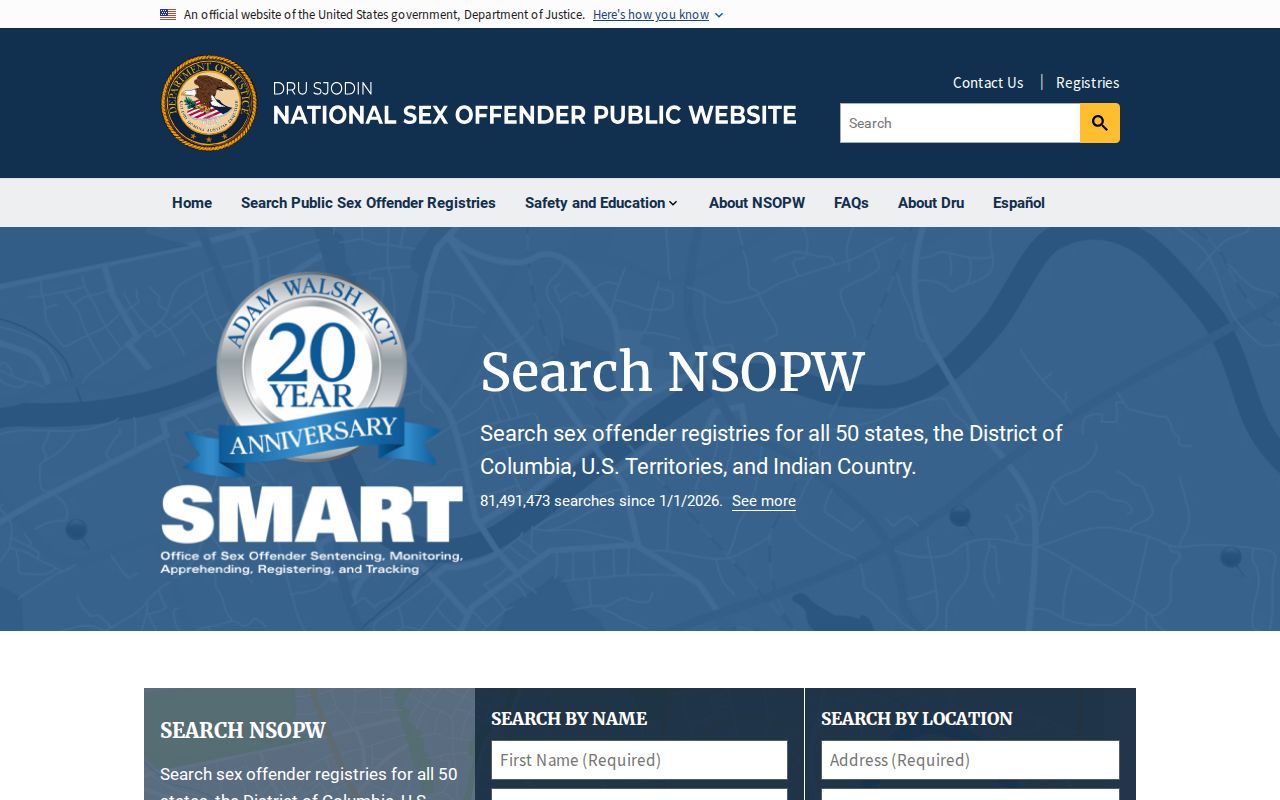
The national layer helps when someone recently arrived on Maui or a name may appear outside Hawaiʻi, but the originating registry remains the authority.
National search is most useful as a bridge, not a replacement. Participating jurisdictions publish different fields and apply different eligibility rules, so the absence of one detail on NSOPW does not contradict a fuller Hawaiʻi profile. When the national results route back to Hawaiʻi, use HCJDC's record for local status and address controls. When they route elsewhere, read that jurisdiction's warning and definitions. E-alerts likewise depend on the address terms a subscriber provides and should be updated when the place of concern changes.
Community Notification and Lawful Use
The Maui County registry supports personal, family, and neighborhood safety planning. Readers may use profiles and e-alerts to stay aware, discuss age-appropriate safety steps, and seek more information from HCJDC or MPD. A result does not justify confrontation. The portal expressly forbids use of its information to injure, harass, or commit a crime against a listed person or anyone in that household.
Misuse can lead to prosecution. HRS §846E-3 prohibits using registry data to injure, harass, or commit a crime, and misuse may create criminal prosecution and civil liability.
Knowing or reckless failure to comply is a class C felony under HRS §846E-9. If a profile appears non-compliant or its location seems wrong, do not investigate in person. Preserve the public details and contact MPD or HCJDC so the responsible agency can review the report.
Community awareness works best when it stays factual. Use official alerts, keep household safety plans focused on conduct and boundaries, and call emergency services when there is an immediate threat. Do not publish a registrant's data elsewhere with added accusations, contact relatives, enter private property, or try to test whether an address is occupied. The portal's warning protects listed people and the public alike by routing possible noncompliance to trained agencies that can compare nonpublic registration records and make a lawful determination.