
Checking Maui County Criminal History
No single Maui County search returns the police report, custody status, filed case, and statewide conviction abstract. Start with eCourt Kōkua when the goal is to understand a Second Circuit criminal case. Its party search accepts a first and last name, with optional middle name, phonetic matching, partial matching, filing dates, and case type. A known case can also be found through a case ID or identifiers such as an arrest number, OTN, or SID. Basic docket facts are free. A PDF icon marks a public document that can be bought online, while the lack of an icon calls for a clerk or courthouse follow-up.
Use the Adult Criminal Conviction Information portal, known as eCrim, for a statewide adult conviction check. It does not disclose pending arrests or non-conviction arrests to the public. MPD Records supplies the underlying police report, and Hawaiʻi SAVIN or VINELink covers custody and parole status. Before searching, gather the full name, likely spelling variants, approximate incident date, and any report, arrest, or case number. Compare identifiers across products before treating two similar names as one person.
- Search eCourt Kōkua by party or case identifiers for filed Maui County matters.
- Check eCrim when a statewide adult conviction abstract answers the question.
- Request the MPD report for the event narrative and agency-held arrest details.
- Use SAVIN or VINELink for current state custody or parole information.
- Call the proper clerk or custodian when an older or public document is not online.
Four Maui Criminal Record Custodians
Maui County records are divided by function, not gathered in a county clearinghouse. MPD creates incident and arrest material. If detention follows, the Hawaiʻi Department of Corrections and Rehabilitation creates intake and custody records at Maui Community Correctional Center. The prosecutor decides which allegations become filed charges, and the Second Circuit Judiciary creates a docket. HCJDC receives arrest cycles and dispositions for the state repository, but its public eCrim product is limited to adult conviction information.
| Official source | Best question | Main limit |
|---|---|---|
| MPD Records | What did police document? | Redactions and requester rules apply |
| MCCC and SAVIN | Is the person in state custody or on parole? | Not a booking archive or case file |
| eCourt Kōkua | What charges and court events were filed? | Sealed and confidential items are excluded |
| HCJDC eCrim | What adult Hawaiʻi conviction is public? | No pending or non-conviction arrest data |
This split explains why a new arrest may be confirmed by Booking & Receiving or MCCC before a court case appears, and why an arrest that did not end in conviction will not appear in a public eCrim result.
Hawaiʻi Official Background Checks
The Hawaiʻi Criminal Justice Data Center, part of the Department of the Attorney General, maintains the central repository. Any public user may run a name search through eCrim. HCJDC calls the result a criminal history record check, police clearance, or police abstract. It reports public adult conviction data, not a complete Maui arrest history. The Wailuku Police Station also has a public eCrim terminal for an in-person printout.
HCJDC handles fingerprint-based state searches with form 073 and its state-run digital-roll, ink-roll, and fingerprint-card services. An individual may also request an FBI Identity History Summary for their own federal record. These official checks serve different scopes. A fingerprint check can provide stronger identity matching, while eCrim is the public name-based conviction product. Neither replaces the local police report or the actual court docket.
The official HCJDC criminal history page shows how Hawaiʻi defines these products.
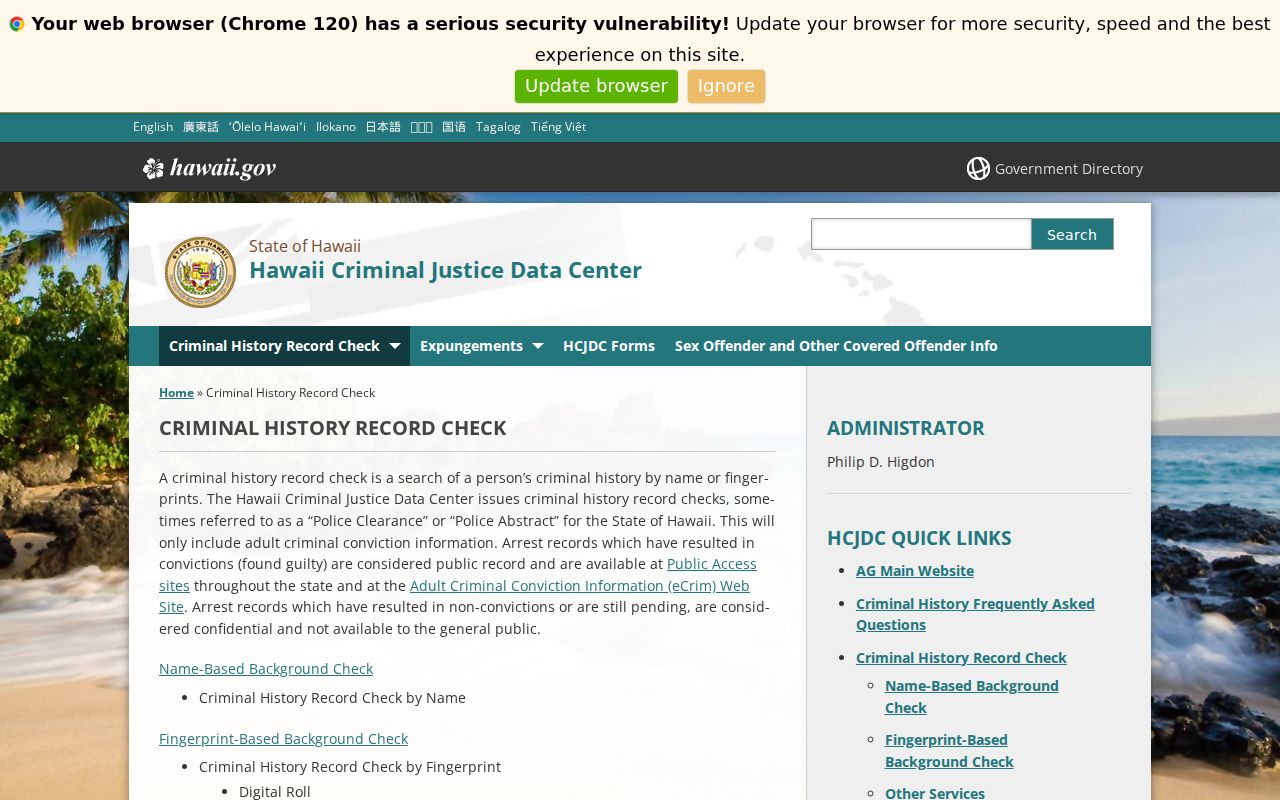
That distinction helps a Maui County reader choose a conviction abstract without expecting it to display pending police or court activity.
Maui County eCourt Kōkua Search
eCourt Kōkua covers Hawaiʻi Judiciary records from Circuit, District, Family, traffic, civil, and appellate matters. Maui criminal cases use the Second Circuit. Person searches require first and last name. Optional phonetic and partial-search controls can catch a spelling variation, while filing dates and case type narrow a broad list. A case search accepts the JIMS case ID and several justice-system identifiers.
| Search control | Use in Maui County |
|---|---|
| Party name | First and last required; middle name optional |
| Phonetic or partial match | Broaden results for spelling variants |
| Case ID | Direct lookup, including Second Circuit JIMS format |
| Arrest Number, OTN, SID | Connect a known booking identifier to a filed case |
| Filing date and case type | Reduce unrelated results |
The Judiciary’s system access page is the source for coverage and document rules.
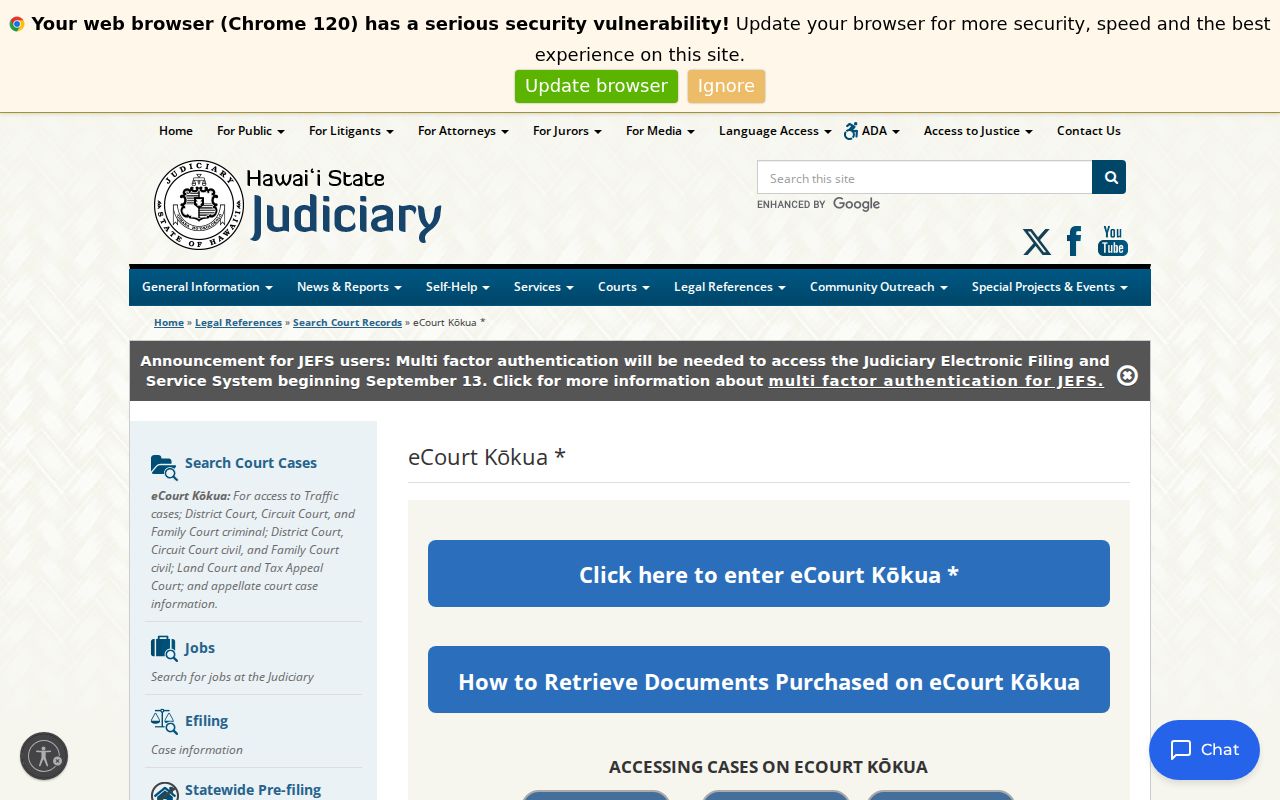
Search results should be read through the Offenses, Events, Dockets, and Disposition areas, rather than from the case caption alone.
Maui County Criminal Record Types
A police incident report describes the response and investigation. An arrest record documents a custody action, and booking material adds intake identifiers. A court case begins only after charges are filed. The court file can then show arraignment, motions, pleas, trial activity, disposition, and sentence. HCJDC’s public abstract is narrower because it reports adult conviction information. Probation and parole records document supervision, while the covered-offender registry is a separate conviction-based public system.
The creating agency remains the first place to resolve an error or request the fuller source record. MPD handles its reports. The Judiciary controls case files. DCR controls MCCC custody operations, and HCJDC maintains the state repository and registry. Warrant information can appear as an event in a known eCourt case, but Maui County has no verified public active-warrant name list.
- Police and booking records: MPD and DCR document the event and custody intake.
- Criminal court files: the Hawaiʻi Judiciary records filed charges and outcomes.
- Conviction abstracts: HCJDC eCrim reports public adult conviction information.
- Warrant events: eCourt codes may reveal activity in a known public case.
- Supervision and registry records: state agencies manage these distinct products.
Maui County Has No Sheriff Jail
Maui County uses a police department, not a county sheriff’s records division. The jail is also a state facility. Maui Community Correctional Center is operated by Hawaiʻi DCR and houses people awaiting adjudication, people serving jail sentences, and some people returning to Maui under correctional programs. It began as a small facility in 1978 and expanded in later phases. This state ownership matters during a search because MPD, not a sheriff, supplies police records, while DCR and MCCC handle custody operations.
The official MCCC facility page provides its current contact and program information.
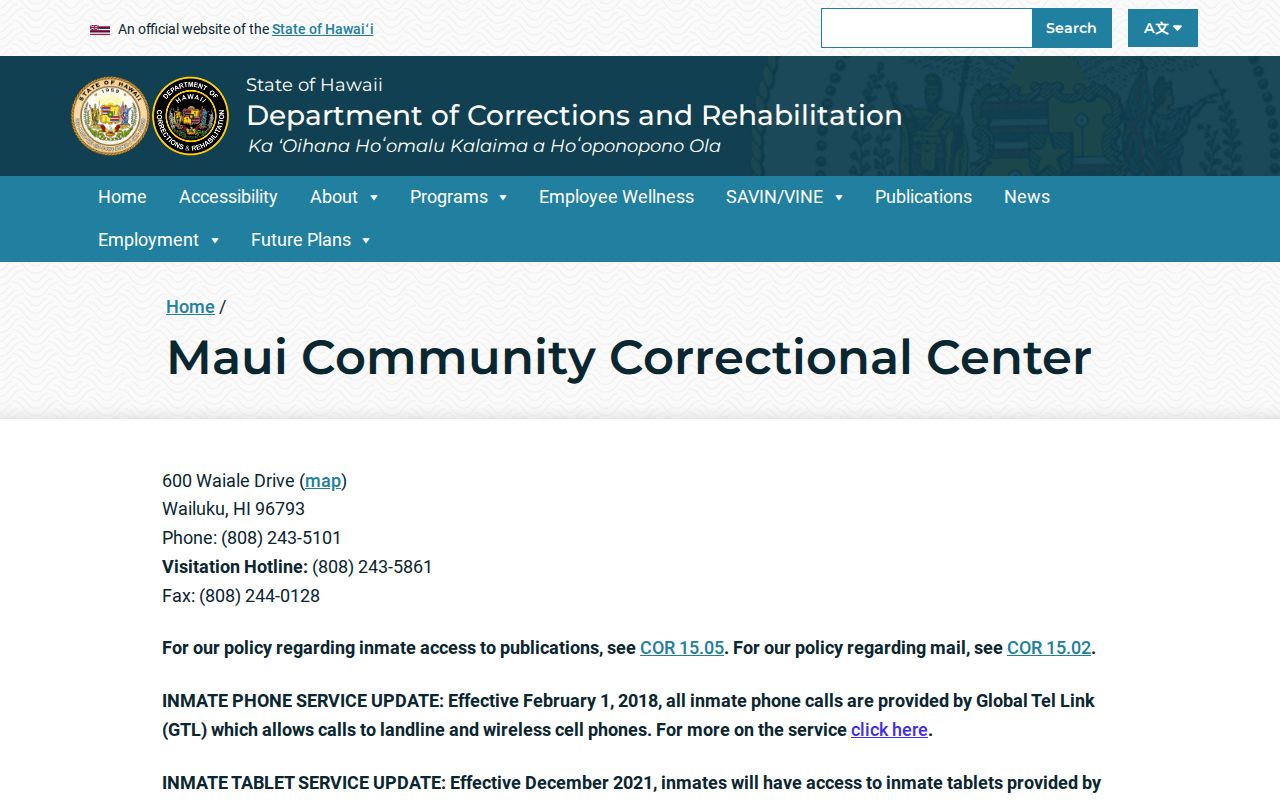
A person seeking a filed charge or final result must still use eCourt Kōkua, because a custody record is not the judicial case file.
Inside a Maui County Criminal Record
The fields depend on the custodian. A police record may list the event, responding officer, allegations, property, and narrative. Booking adds intake identifiers, fingerprints, photograph, custody status, and possible bond or release information. A court file identifies the parties, case type, court, charges, docket events, disposition, and sentence. HCJDC links an arrest cycle to reported dispositions, but public eCrim suppresses pending and non-conviction arrest information.
| Name & Identifiers | Displayed name, aliases, date details where public, JIMS Party ID, SID, OTN, or arrest number |
|---|---|
| Arrest / Booking Data | Event date, agency, alleged charge, intake, and release or custody information |
| Charges & Statutes | Filed count, offense description, level, and Hawaiʻi statute citation |
| Disposition | Outcome for each count, such as dismissal, plea, acquittal, or conviction |
| Sentence | Custody, probation, fines, and other terms entered by the court |
| Custody / Supervision Status | DCR custody or parole through SAVIN; public probation sentence through the court file |
Maui County Custody Through SAVIN
Hawaiʻi SAVIN and VINELink provide free custody and parole lookup and notification. A user may search online, use the official app, or call 1-877-846-3444. Notifications can arrive by telephone, text, email, or app. DCR cautions that status can change, so urgent safety decisions should not depend on the service alone. MCCC’s main line and MPD Booking & Receiving provide fallback guidance when a recent Maui County arrest has not yet settled into the public systems.
The DCR SAVIN information page explains the state service.
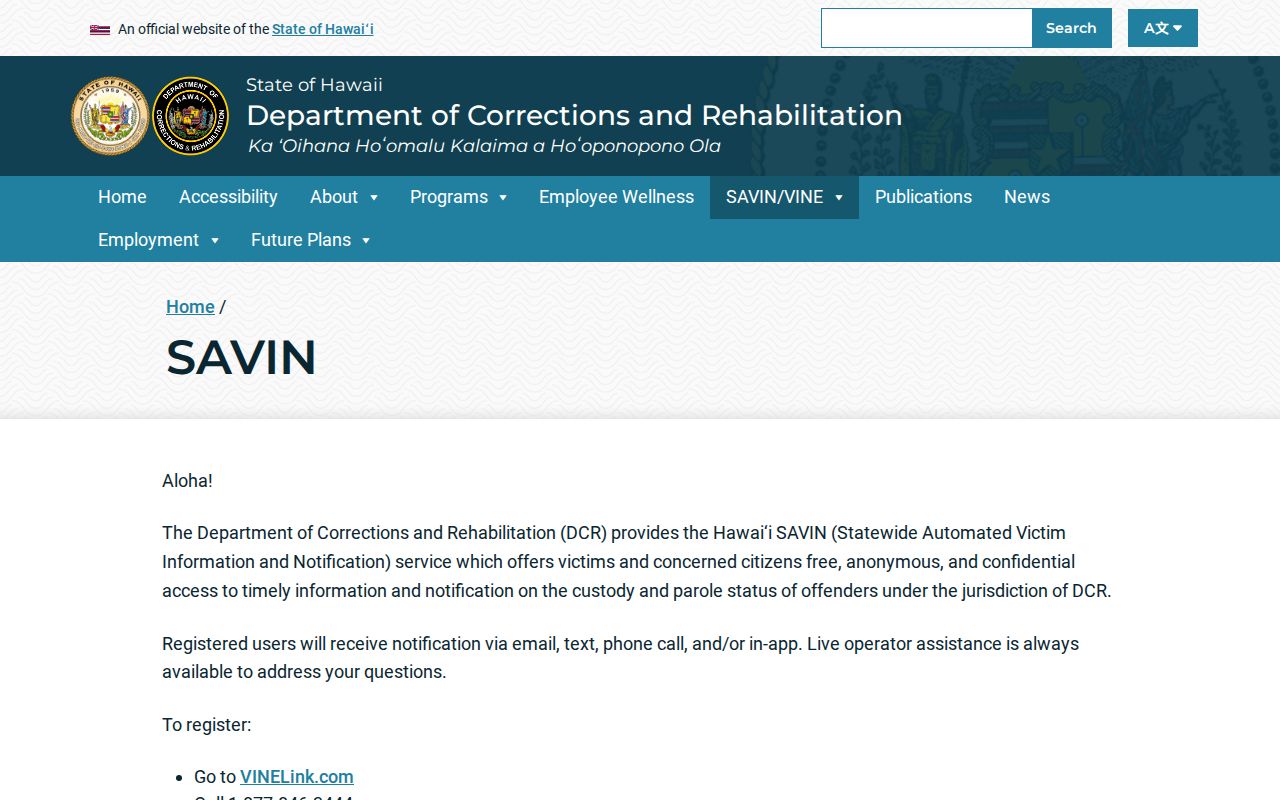
The search itself runs through VINELink’s custody interface.
Neither screen should be read as a complete booking log, mugshot archive, or substitute for the court disposition.
Public Access Laws in Hawaiʻi
Hawaiʻi’s Uniform Information Practices Act, or UIPA, governs access to county and state agency records while preserving privacy and other statutory exemptions. Criminal history dissemination has separate rules under chapter 846. Court access follows Judiciary rules, and covered-offender publication follows chapter 846E. These laws do not make every record public. Juvenile, sealed, in-camera, victim, personal identifier, medical, security, and active-investigation information may be withheld or redacted.
Key Hawaiʻi laws:
HRS chapter 92F governs public access and privacy under UIPA.
HRS chapter 846 controls criminal history record administration and dissemination.
HRS chapter 846E defines covered-offender registration and public information.
HRS § 831-3.2 provides the main non-conviction arrest expungement process.
Maui County UIPA Request Fallback
When no public database supplies a releasable county record, use Maui County’s GovQA UIPA portal. Select “Submit a Request,” choose the request type, sign in or create an account, describe the record, attach useful documents, and track agency updates. For an MPD report, provide the report number or the date, time, and place of the event, plus a legible government photo ID. A representative needs signed authorization and the qualified requester’s ID.
MPD accepts mail and fax as alternatives. Most reports arrive within ten business days, but that is an expectation rather than a guarantee. An involved victim, offender, driver, pedestrian, vehicle owner, or owner of affected property may qualify for a less-redacted copy than an anonymous or uninvolved requester. Search and segregation charges may apply under state administrative rules.
The Maui Police Department site identifies the countywide agency and its services.

Because Maui County has no city police departments, its six MPD districts route report fulfillment through central Records in Wailuku.
Sealed, Expunged, and Restricted Records
HRS § 831-3.2 permits expungement of qualifying non-conviction arrest information. Eligibility can cover arrests that did not lead to conviction, subject to statutory exceptions and waiting conditions. HCJDC accepts the application and fee, checks the arrest cycle, and issues an expungement order when the legal requirements are met. Limited conviction expungement routes exist under specific Hawaiʻi statutes, but a general conviction does not disappear merely because time has passed.
Since July 1, 2025, HCJDC automatically transmits qualifying orders to the Judiciary so a court can consider sealing or removing the related public electronic case record. That added step matters because clearing the repository record did not historically erase every agency copy. Sealed, juvenile, and confidential records can remain available to authorized agencies even when omitted from a public portal. A missing public result alone does not prove that no restricted record exists.
Maui County Record Search Fees
Similar-sounding products carry different prices because they come from different custodians and offer different proof. Confirm fees before ordering because operational details can change.
| Product | Current researched fee | What it provides |
|---|---|---|
| eCrim name search | $5 | Search of public adult conviction information |
| Resulting certified eCrim record | $12 | Certified record returned from the name search |
| MPD lobby abstract | $25 | Public-terminal criminal abstract printout |
| HCJDC embossed product | $30 | In-office or mail criminal history product |
| Fingerprint state search | $30 | Fingerprint-based Hawaiʻi repository search |
| eCourt document | $3 or $0.10 per page | Whichever amount is greater for a file-stamped copy |
Free options still help. eCourt basic case facts and courthouse terminal viewing cost nothing. SAVIN custody searching is also free. A police report under twenty-five pages has no stated copy fee, although voluminous copies, media, search, and segregation can lead to charges.
Maui County Warrant Search Fallback
No verified public MPD active-warrant name database exists. For a known or party-linked case, inspect eCourt Kōkua events for codes such as BWO, BWT, BWS, BWU, or BWRC. These can mean a bench warrant was ordered, created, served, returned unserved, or recalled. Confirm the event with the District or Circuit clerk. A sealed search warrant or confidential case may not appear online.
For safe law-enforcement instructions, call MPD’s nonemergency number rather than arriving without guidance. Crime Stoppers is a tip channel, not a warrant-confirmation service. A bench warrant commonly concerns a missed appearance or failure to comply, while an arrest warrant starts a custody process and a search warrant authorizes a search. A clean name search cannot rule out every warrant category.
Maui County Criminal Records by City
Hawaiʻi has no incorporated municipalities below the county level, so Kahului, Kīhei, and Wailuku are census-designated places rather than cities with separate police departments or municipal courts. Their community pages explain the MPD district station and state court channels that actually serve each place. Kahului and Kīhei route report copies to central MPD Records. Wailuku contains that records counter, Hoapili Hale, MCCC, and prosecutor offices.
Kahului Criminal Records
28,219 · MPD District I and state Second Circuit channels
Kīhei Criminal Records
21,423 · Kīhei Patrol with centralized report fulfillment
Wailuku Criminal Records
17,697 · Maui County’s police, court, and custody records hub
Wailuku Maui Criminal Records Hub
Wailuku’s value is physical proximity, not a unified database. MPD Records is at 55 Mahalani Street and handles report copies, booking contacts, and the public eCrim terminal. Hoapili Hale at 2145 Main Street houses the Second Circuit record functions, District and Family clerks, probation contacts, and public terminals. MCCC is nearby at 600 Waiale Drive but belongs to state DCR. Each counter answers a different question.
The official Second Circuit Maui directory identifies the courthouse offices and rural court contacts.
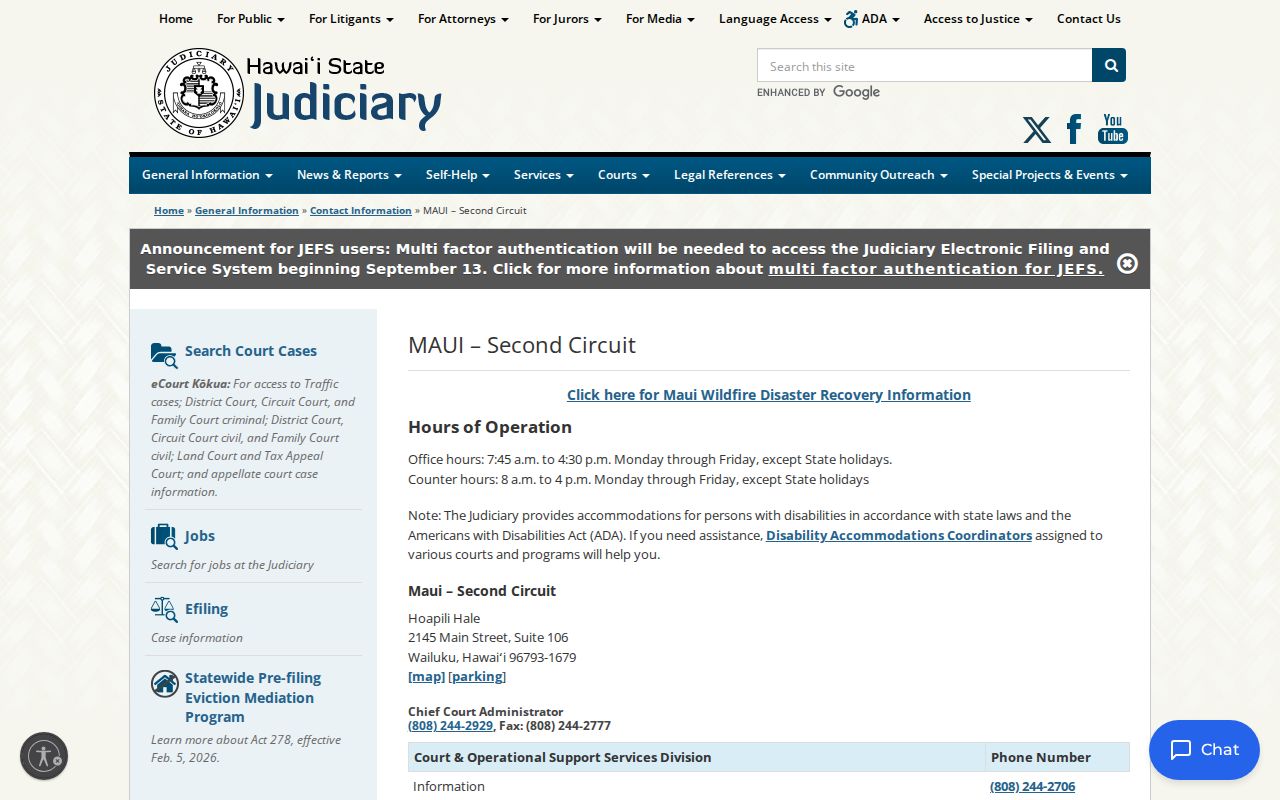
Files more than five years old may be stored off site, so calling Legal Documents before a trip can prevent an unnecessary visit.
Maui County Government Record Routing
The County of Maui government directory helps route UIPA requests, police matters, and prosecutor contacts without implying that county government controls the state courts or jail. Kalana O Maui houses the main county information and UIPA administration. The Prosecuting Attorney’s Circuit Division handles felonies, its District Division handles misdemeanors, and Family Division handles specified family and juvenile matters. Charging records do not replace the court docket, and prosecutor staff do not serve as the clerk.
The County of Maui homepage is the official department directory.
Using the named custodian is especially important across Maui, Molokaʻi, and Lānaʻi, where MPD and the Second Circuit serve several districts and islands.